Leonard Vincent
The Door into SummerLeonard Vincent is an architecture-school drawing instructor with an engineer’s practical cast of mind who volunteers for Hubert Twitchell’s experiment in major temporal displacement. He disappears from the laboratory after setting out to travel five hundred years through time, and neither Twitchell nor the novel can establish where he went. Dan Davis’s later speculation that Vincent may have become Leonardo da Vinci gives the disappearance an arresting possible place in history, while leaving it unresolved.
Identity and Introduction
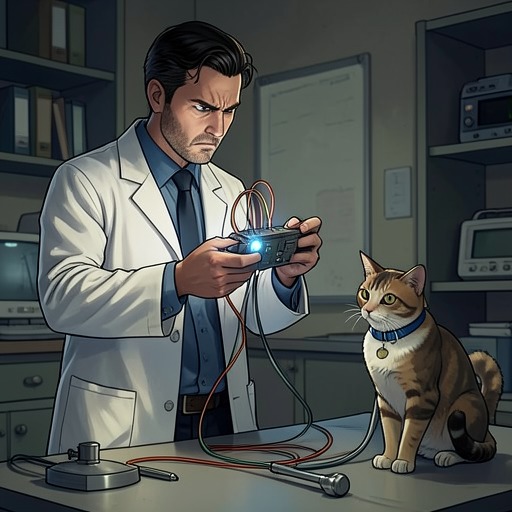
Vincent is introduced through the recollections of people connected to Twitchell’s time-displacement work. Chuck Freudenberg remembers him as “this bird, Leo Vincent,” using the familiar name Leo, and identifies him as an instructor who came to the laboratory with Twitchell. Freudenberg waited outside after Twitchell sent him home. Twitchell eventually emerged; Vincent did not. As far as Freudenberg knew, Vincent remained inside, and he was no longer teaching at Boulder afterward.
Twitchell’s account supplies the detail behind that abrupt absence. He says that preliminary experiments suggested living subjects could undergo temporal displacement without harm. He had confided in Vincent, a young colleague who taught drawing and other subjects in the school of architecture. Twitchell describes him as more of an engineer than a scientist, but praises his lively mind. Vincent was eager to test the process on himself through a major displacement of five hundred years; Twitchell admits that he allowed him to do so.
The Experiment and Disappearance
Vincent’s disappearance is reported indirectly, through incomplete testimony rather than a witnessed arrival in another period. Freudenberg’s account establishes the sequence he observed: Vincent and Twitchell entered the lab, Twitchell told Freudenberg he could leave, and only Twitchell came back out. Freudenberg also recalls that two students were involved in the same episode. All three subjects entered with Twitchell, but only Twitchell emerged; one student was in class the next day, while the other was absent for a week. The contrast leaves the students’ outcomes distinguishable from Vincent’s, but gives no further account of Vincent’s fate.
Twitchell cannot say whether the five-hundred-year displacement carried Vincent forward or backward. He explains that the equations are symmetrical and the chances precisely even, so Vincent could have landed in the fifteenth century or the twenty-fifth. The experiment therefore leaves a striking gap between its intended scale and what its participants can know: the disappearance is certain, but its destination and consequences are not.
Twitchell’s Regret
For Twitchell, Vincent’s fate becomes the reason not to repeat the experiment casually. He says the attempt added nothing to the data, and that if Vincent went forward, the result might be acceptable; if he went backward, however, Twitchell may have sent his friend to die among people and dangers of an unfamiliar age. His account frames Vincent not as a test result but as a friend whose fate cannot be checked within Twitchell’s lifetime. The uncertainty is ethical as well as scientific: Twitchell’s willingness to permit the trial persists alongside his fear that he exposed someone he cared about to consequences he could not control.
Twitchell’s caution also clarifies the difference between preliminary results and this major trial. Earlier work, he says, indicated that living subjects could be displaced without harm, but Vincent’s requested journey extended five hundred years and left the experimenters without a practical way to verify what had happened. The evidence supports neither a confirmed death nor a confirmed survival in another era. Twitchell’s regret rests precisely on having to imagine outcomes that the experiment cannot resolve.
The Leonardo Hypothesis and Historical Significance
Much later, Dan Davis says he cannot get Vincent out of his mind and wonders whether Vincent was Leonardo da Vinci. The possibility follows from the earlier account of the symmetrical displacement: if Vincent went backward, he might have reached Renaissance Italy and entered history under another identity. Davis also imagines that Vincent could have crossed the continent and returned with Columbus, and observes that fifteenth-century Italy lacked social-security numbers, identity cards, and fingerprints. These are conjectures, not a revelation that Vincent actually became Leonardo or joined Columbus’s voyage; the narrative offers them as possibilities Davis cannot dismiss.
Davis’s speculation gives Vincent’s disappearance a larger consequence without closing the mystery. A person transported into the past might be able to alter the historical record or fit into it under an assumed identity, but would be stranded without the accumulated skills and infrastructure of the future. Davis pictures Vincent as possessing knowledge of flight and power yet unable to turn such knowledge directly into working inventions, because present-day achievements depend on centuries of prior art. The thought makes temporal displacement more than a change of date: it separates knowledge from the historical conditions that make knowledge usable.
Vincent’s unresolved fate also fits Davis’s account of a single, self-consistent world in which time travel belongs to history rather than creating a separate one. If Vincent did travel backward and become Leonardo, that outcome would be part of the past Davis already inhabits, not an escape from it. The novel does not confirm this loop; instead, Vincent remains its suggestive, absent center. His disappearance connects Twitchell’s experiment to Davis’s later reflections on time, historical identity, and the limits of individual action within a past and future that remain linked.